
Fall 2026 Newsletter
Former Fellow Named McKnight Scholar

2017 Fellow Astra Bryant Ph.D.
2017 Fellow Astra Bryant, Ph.D., Assistant Professor of Neurobiology and Biophysics at the University of Washington School of Medicine, is one of 10 newly named 2026 McKnight Scholars. The McKnight Scholars Awards are granted to neuroscientists who are in the early stages of establishing their own independent labs and research centers. Recipients receive three years of financial support and join a community of neuroscience researchers who meet annually.
Astra earned her Ph.D. in neuroscience at Stanford University and did her postdoctoral research in Ellisa Hallem’s lab at UCLA. Motivated in part by the startling statistic that soil-transmitted parasitic roundworms, or nematodes, infect over a billion people worldwide, Astra studies how the nervous systems of these parasites control their infestation behavior. Interestingly, the nervous systems of parasitic nematodes are very similar to non-parasitic C. elegans, but C. elegans avoid warm temperatures. In contrast, parasitic roundworms locate hosts using body heat and survive and reproduce for many months in host tissues. The Bryant Lab seeks to identify the specific molecular and neural adaptations that shape the behavior of parasitic worms. This research could inform the development of new treatments for millions of patients.
“One thing we don’t really understand in the field of neuroscience is how common neural circuits produce a stunning diversity of behavior,” Astra explained. “Parasitic worms provide us with a wonderful opportunity to link molecular and neural mechanisms to fundamental differences in behavior.”
The McKnight Foundation recognizes the importance of Astra’s research for its potential impact in treating a neglected disease as well as revealing fundamental principles underlying the evolution of sensory behaviors. You can read more about Astra’s research here.
Former Fellow Develops New Approach to Clearing Hard-to-Treat Disease Proteins;
Earns Early Tenure At UC Irvine
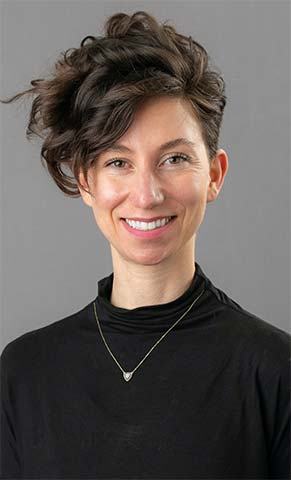
2019 Fellow Lauren Albrecht, Ph.D., is an Associate Professor in the School of Pharmacy and Pharmaceutical Sciences at UCI. Lauren is a trained chemist, earning both her bachelor’s degree from UC San Diego and Ph.D. from Northwestern University in chemistry. She applies her knowledge of chemistry to biological processes and seeks to understand how they go awry in disease.
Lauren’s postdoctoral research, which she conducted under the mentorship of developmental biologist Edward De Roberts at UCLA, examined how diet can impact the metabolism of cells. Specifically, Lauren found that decreasing methionine — an essential amino acid in meat, tofu, and milk – in the diet reduced tumors of the liver and colon in mouse models. Lauren’s research has thus contributed to the development of suggested diet changes that can help with various cancers.
Expanding on this line of research, the Albrecht Laboratory studies methylation, a fundamental and essential chemical process that helps control genes, repair DNA, and manage daily life by expelling from cells unwanted proteins. Lauren and her team have developed a molecule, MrTAC (Methylarginine-Targeting Chimera), which binds onto proteins that drive neurodegeneration in cancer and heart disease. Once bound to these proteins, MrTAC drags those unwanted proteins to the lysosome — the part of the cell that acts like a garbage disposal — where they are broken down. The Albrecht Lab is testing the potential of this new therapy in mouse models and hopes that the results lay the groundwork for clinical trials.
This research, coupled with her success in securing a Research Project Grant from NIH and other private funding, positioned Lauren to earn tenure in less than 5 years. As she reflects on her A.P. Giannini Foundation fellowship and how it contributed to her success as a researcher, Lauren describes the award as “life changing.” She noted that in addition to enabling her to pursue her research, the communications and leadership training have stayed with her. “Before the leadership training, I didn’t know what an Enneagram was.” (The Enneagram is a personality model that sorts human behavior into nine distinct types.) “Now, everyone in my lab does the Enneagram, and their result is on their lab page.” Lauren said this information has proven very helpful in interacting with others, and she is incorporating this approach into a proposal for a T32 training award grant from NIH.
To learn more about Lauren’s MrTAC research, click here. Other research articles may be accessed here.
2022 Fellow Studies New Potential Target for Alleviating Pain in Chronic Diseases;
Launches New Lab at UC Irvine

2022 Fellow Donovan Argueta, Ph.D.
2022 Fellow Donovan Argueta, Ph.D., was recently appointed Assistant Professor of Medicine in the Division of Hematology and Oncology at UC Irvine. Donovan earned his Ph.D. in bioengineering at UC Riverside and carried out his postdoctoral research in Dr. Kalpna Gupta’s lab at UC Irvine.
Donovan shared that his situation is unique in that he’s setting up a lab at the same institution where he had completed his fellowship. “I applied broadly for academic research positions and had the opportunity to talk to other institutions. The question for me was, ‘What’s the setting that’s going to help me to do the best research?’” Donovan ultimately decided that UCI provided the most supportive environment, and he and his mentor engaged in frank discussions about the research that Donovan’s lab would undertake and how it would be distinct from that of the Gupta Lab.
Donovan’s research focuses on the endogenous cannabinoid system (ECS) as a potential target as an adjuvant or complementary therapy for alleviating both pain in chronic diseases such as sickle cell disease and adverse side effects of existing pharmacological treatments such as chemotherapy in cancer patients. The ECS is a complex cell-signaling network in the human body that regulates critical functions like sleep, appetite, memory, and pain sensation; its primary goal is to maintain homeostasis in a changing environment.
Fundamentally, Donovan seeks to understand the basic biology that drives some of the issues that patients experience in order to improve their quality of life: “The research question I’d like to ask, particularly for chronic diseases, is can we alleviate pain as well as some of the cognitive impairments that accompany existing treatments with complementary therapies that draw upon systems of the body?”
Donovan credits the leadership training he had as an A.P. Giannini Fellow with helping him to articulate his research plan as well as a leadership vision for trainees. “I still find when I’m interacting with people in the lab on a daily basis, I use some of the skills that I learned during the leadership retreat, including delegating, providing instruction, encouraging students to push through tasks that they need to learn how to do themselves, etc. These are practical skills that have proven really helpful.”
Click here to learn more about Donovan’s research.