
Summer 2026 Newsletter
Former Fellow Co-Founds Start-Up Pursuing a New Class of Cancer Therapies
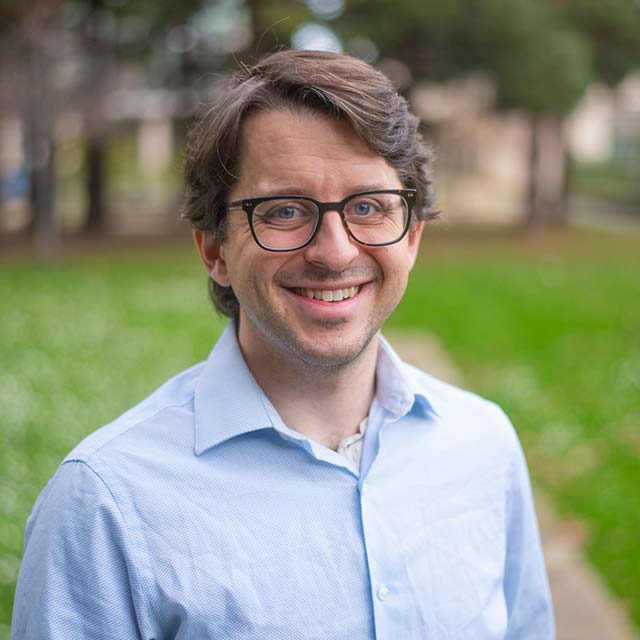
2023 Fellow Corleone Delaveris, Ph.D.
2023 Fellow Corleone Delaveris earned his Ph.D. in Chemistry and Chemical Biology from Stanford. His postdoctoral research project, “Targeting the Extracellular Phoshoproteome,” was carried out under the mentorship of Jim Wells, Ph.D., Professor of Pharmaceutical Chemistry at UCSF.
As described in a recent first-author paper in Science, Corleone and other researchers at UCSF discovered that Src, a cancer-causing enzyme, appears on the surface of certain tumor cells – but not on the surface of healthy cells. The team also showed that Src is not the only protein that gets expelled from cancer cells in this way. Once on the surface of a cell, these proteins act like a flag that can be targeted by potential therapies. If therapies can target just these externalized proteins, then healthy cells are spared from treatment.
During his postdoc, Corleone spent several months raising capital to co-launch a start-up, Inversion Therapeutics, which seeks to develop new therapies that target these inverted proteins. Inversion Therapeutics’ researchers are currently studying why these proteins are expelled by cancer cells. Understanding this process will confirm the hypothesis that targeting these proteins on a cell’s surface will lead to an effective treatment. This work will also inform the types of tumors that are prone to this externalization process. Inversion Therapeutics is laying the groundwork to bring potential therapies to a clinical trial.
While acknowledging the challenges of fundraising and operating a business, Corleone says he gains personal gratification from having the opportunity to realize the “bench to bedside” paradigm. “I see the light at the end of the tunnel,” he said. “I very much see a path to help patients that have cancers that might not otherwise be treatable.”
Corleone credits the Foundation’s communications training for helping him to communicate effectively and broadly with scientists in other fields and venture funds as he sought start-up support. “The communications training made a significant difference,” he said.
Current Fellow Recognized for her Novel Approach to Researching Lupus
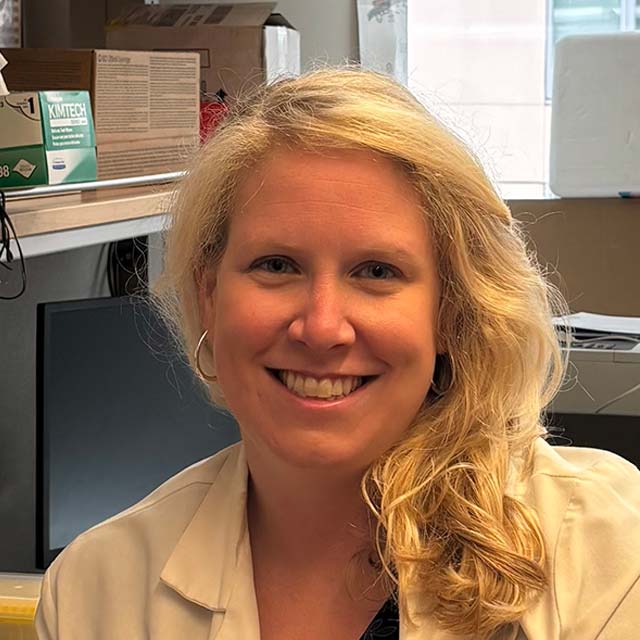
2024 Fellow Kristen Mengwasser, M.D., Ph.D
2024 Fellow Kristen Mengwasser, M.D., Ph.D., is carrying out her postdoctoral research under the mentorship of Drs. Alexander Marson and Mark Davis at UCSF in the Division of Rheumatology. Kristen, who earned her Ph.D. in Biological and Biomedical Sciences at Harvard Medical School, studies lupus, an autoimmune disease in which the human immune system becomes hyperactive and attacks healthy tissues. Symptoms can affect many different body systems, including the joints, skin, kidneys, blood cells, heart and lungs.
Kristen is developing a novel approach to studying lupus by using human tissue as opposed to more traditional mouse models. Specifically, by using human tonsil tissue, Kristen is creating miniature replicas of the human immune system, or organoids, that can be studied in a petri dish. These organoids can produce the same autoantibodies that are seen in lupus patients; autoantibodies are proteins produced by the immune system that mistakenly target and attack the body’s own healthy tissues instead of foreign invaders like germs. Kristen’s goal is to find a treatment that eliminates harmful autoantibodies but leaves the rest of the immune system intact. This same approach can be applied to other autoimmune diseases such as Multiple Sclerosis and Type 1 Diabetes.
In a forthcoming paper, Kristen describes how one existing treatment, mycophenolate, a potent immunosuppressant, works in lupus patients. While this medication has been available for 30 years, little has been understood about the exact way it works. While effective, this existing treatment has many drawbacks, as it weakens the body’s immune system as a whole. “Studying how mycophenolate works in organoids teaches us about the disease’s underlying behavior, which can lead to the development of more targeted precision therapies,” Kristen explains.
The Arthritis National Research Foundation, or ANRF, recently recognized Kristen with a Postdoctoral Research Award. The award supports future directions of Kristen’s project, including understanding the biology of lupus and learning how treatments interact with the disease. In addition, Kristen, a physician-scientist, received a Distinguished Fellow Award from the American College of Rheumatology in 2025. She also received the 2026 Irene Perstein Award to support the development of outstanding new female physician attendings at UCSF.
You can learn more about Kristen’s research by watching this short talk.
Foundation Pilots Virtual Series on Career Transitions
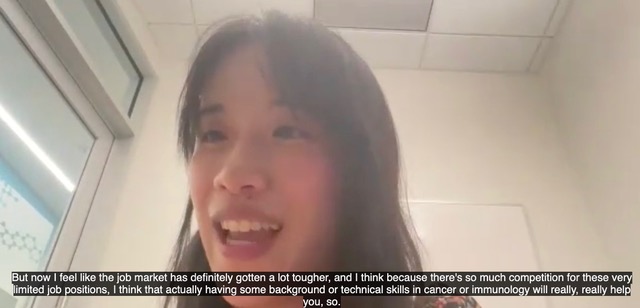
2021 Fellow Connie Fung, Ph.D.
The Foundation is piloting a series of virtual sessions with former fellows to discuss topics aimed at assisting current fellows with their career transitions. The first of these sessions, “Rewarding Careers Outside of Academia,” was held in February and featured three distinguished former fellows: 2021 Fellow Connie Fung, Ph.D., Senior Scientist (Inflammation) at Gilead Sciences; 2008 Fellow Andrew Hebbeler, Ph.D., Director of Biosecurity at CEPI (Coalition for Epidemic Preparedness Innovations); and 2005 Fellow Jennifer (Jenni) Weisman, Ph.D., Head of Strategic Alliances, Biotech Accelerator at the Gates Foundation. The discussion was moderated by D. Keith Grossman, one of the Foundation’s directors and Vice Chairman of Alcon, Inc.
Connie, Andrew and Jenni discussed why they chose their respective career pathway, how they got to where they are, and what they find fulfilling about their roles. The conversation began with each panelist explaining why they made the decision to leave academic research. Andrew shared that he found working in the lab to be isolating. He advised fellows, “Be honest with yourself about the things that you like and don’t like and the things you’re good at and you’re not good at.” Jenni said that while she found her postdoctoral research project interesting, she “wasn’t sure that it was something that [she] wanted to work on the for the rest of [her] life.” Both Andrew and Jenni initially transitioned from research to government roles through a one-year fellowship sponsored by the American Association for the Advancement of Science, or AAAS, which places PhDs into various roles in the government. As for Connie, she was committed to research, but she was also committed to staying in the Bay Area; prominent labs in her field of research already exist at area medical schools. Connie spent the last years of her postdoc improving her immunology skill set as she recognized that having a background or technical skill set in immunology — or cancer – would set her up for success as she pursued job opportunities in the private sector.
All three panelists are happy in their current roles, and they discussed what has contributed to their success. The scientific method has provided Andrew with a structure for tackling problems – a framework that many of his colleagues do not have. He, Jenni and Connie all emphasized the importance of oral and written communication skills in their respective roles. “Being able to communicate clearly and succinctly is very important,” Connie said. “You’re constantly in meetings, and you’re constantly presenting your data and your findings and explaining to leadership why you’re making certain decisions about a project.”
To this end, the Foundation offers one-on-one communications training to its fellows and works to identify ways to prepare its fellows to become leaders in their respective fields. The Foundation’s next virtual panel will help fellows to evaluate and negotiate academic job offers.